Art
Intent
At Hunnyhill Primary School, we value Art and Design as a vital part of the children’s entitlement to a broad and balanced curriculum; underpinned by our school value of ‘Creativity’. Our Art and Design curriculum is supported by ‘Kapow’ and provides the children with the opportunities to develop and extend art skills and knowledge, further encouraging our school value ‘Challenge’ to strive for personal progression. Our Art and Design curriculum offer gives children an opportunity to express their individual interests, thought and ideas.
A high-quality art and design education should engage, inspire and challenge pupils, equipping them with the knowledge and skills to experiment, invent and create their own works of art, craft and design. Art contributes to children’s a sense of belonging and ownership by providing opportunities for children to showcase work to others and having collaborative experiences; linking to our school motto ‘Proud to Belong’ and value of ‘Teamwork’ . It creates a positive and inclusive experience where children are not afraid to make mistakes, developing ‘Resilient’ learners.
As pupils progress, they should be able to think critically about their own work and the work of other artists. In turn to develop a more rigorous understanding of art and design, whilst having ‘Respect’ for other artists work . Art planning should incorporate progression of skills and be used as a platform for personal expression and the development of individuality; supported by our school value, ‘Independent’ . Authentic opportunities should be incorporated, offering real world challenges and examples, such as historical references and cross curricular links. Children will also learn how art and design both reflect and shape our history and contribute to our culture.
Implementation
How is our Art curriculum organised?
| National Curriculum Aims for Art | |||||||
| Generating Ideas | Using Sketchbooks | Making skills (including formal elements) | Knowledge of Artists | Evaluating and Analysing | |||
| Scheme of work | |||||||
| Drawing Exploring mark-making in all its forms, experimenting with line, tone and texture and using a wide range of materials to express their ideas as drawings. Using sketchbooks to record observations and plans as drawings. Learning about how artists develop their ideas using drawings. | Painting and Mixed Media Developing painting skills including colour mixing, painting on a range of surfaces and with different tools. Exploring the interplay between different media within an artwork. | Sculpture and 3D Investigating ways to express ideas in three-dimensions. Constructing and modelling with a variety of materials, shaping and joining materials to achieve an outcome. Developing drawn ideas into sculpture | Craft and Design Designing and making art for different purposes, considering how this works in creative industries. Learning new making techniques, comparing these and making decisions about which to use to achieve a particular outcome Developing personal, imaginative responses to a design brief | ||||
Our Art scheme of work is designed with five strands that run throughout.
These are:
• Generating ideas
• Using sketchbooks
• Makings skills, including formal elements (line, shape, tone, texture, pattern, colour)
• Knowledge of artists
• Evaluating and analysing
Units of lessons are sequential, allowing children to build their skills and knowledge, applying them to a range of outcomes. The formal elements, a key part of the national curriculum, are also woven throughout units. Key skills are revisited again and again with increasing complexity in a spiral curriculum model. This allows pupils to revise and build on their previous learning. Units in each year group are organised into four core areas:
● Drawing
● Painting and mixed media
● Sculpture and 3D
● Craft and design
National curriculum mapping shows which of our units cover each of the National curriculum attainment targets as well as each of the strands.
Our Progression of skills, knowledge and vocabulary show what is taught within each year group and how this develops to ensure that attainment targets are securely met by the end of each key stage. It also shows how knowledge builds in the formal elements of Art.
Our units fully scaffold and support age-appropriate sequenced learning and are flexible enough to be adapted to form cross-curricular links personalised to our children’s needs. Creativity and independent outcomes are robustly embedded into our units, supporting students in learning how to make their own creative choices and decisions, so that their art outcomes, whilst still being knowledge-rich, are unique to the pupils.
Art is taught within our fortnightly rotation of foundation subjects. Lessons are always practical in nature and encourage experimental and exploratory learning with pupils using sketchbooks and Book Creator to document their ideas. Differentiated guidance is available for every lesson to ensure that lessons can be accessed and enjoyed by all pupils and opportunities to stretch pupils’ learning are available when required.
Knowledge organisers for each unit support pupils by providing a highly visual record of the key knowledge and techniques learned, encouraging recall of skills processes, key facts and vocabulary. Knowledge Organisers also provide support recall of previous learning.
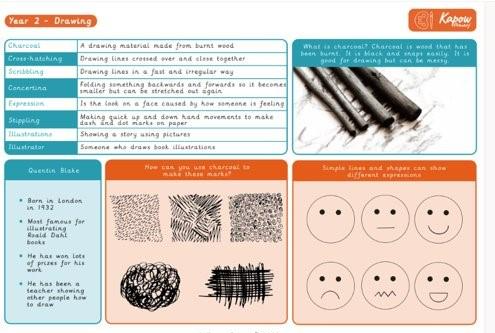
Vocabulary progression is key within our curriculum. Key vocabulary for each learning journey is identified and discussed with the children at the beginning of the journey. Children then highlight when vocabulary is used in lesson to help build a bank of vocabulary terms. Vocabulary is based on art techniques, processes and artist analysis. To support children to remember key terms, some vocabulary recaps previous units or progresses to deeper understanding of that term, for example in a different art medium or with more complex discussion.
Our curriculum supports teachers in their own professional development. Pupil videos created by subject specialists help pupils to see art techniques modelled by experts, to ensure the delivery of Art is of the highest quality. Each unit of lessons includes multiple teacher videos to develop subject knowledge and support ongoing CPD. Our curriculum has been created to ensure that teachers feel supported to deliver lessons of a high standard that ensure pupil progression.
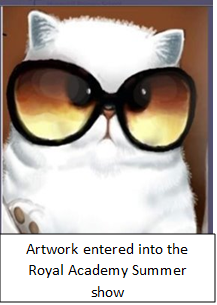
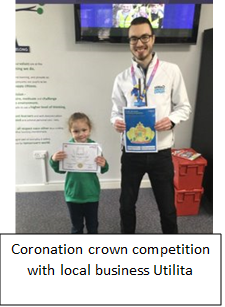
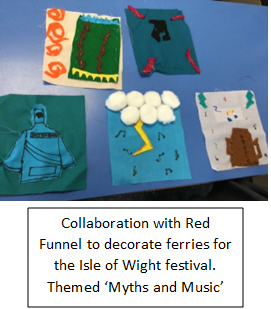
Competitions and community projects run throughout the school year to encourage children to use their Art skills for a purpose and raise the profile of Art across the school. These include working with Red Funnel, a local ferry company, to decorate the ferries for the Isle of Wight festival period. Also working with local shops to decorate windows to celebrate the NHS and some children had their work entered into the Royal Academy Summer Show.
In addition to our Art core curriculum coverage, Hunnyhill also encourage Art enrichment oppotunities. All children take part in an Art day every year. Each class complete learning about an artist of their choice, producing work in the style of that artist. Children then have the opportunity to share their work with their families duyring our whole school Art gallery open afternoon.
In addition, Hunnyhill take part in ‘Creative Careers Week’ each year. This gives opportunities for our KS2 children to take part in workshops and visits designed to give Art experiences that shape aspirations to work in Creative Careers. These experiences include: ‘Creative Carnival’, visits to Quay Arts Art Gallery, visits to the Isle of Wight College for taster sessions in Photography, Media, Art and Design, Performing Arts and Graphics, ‘Shademakers’ and working with local artists (e.g Kathy Williams) to create large scale artwork.
Impact
Our art curriculum, based on Kapow Primary curriculum is designed in such a way that children are involved in the evaluation, dialogue and decision making about their art outcomes and the improvements they need to make. By taking part in regular discussions and decision-making processes, children will not only know facts and key information about art, but they will be able to talk confidently about their own journey and have a growing understanding of how to improve. The impact of this scheme can be monitored through both formative and summative assessment opportunities. Each lesson includes guidance to support teachers in assessing pupils against the learning objectives. Our adapted assessment sheets for each unit include the learning outcomes for children with secure understanding and those working at greater depth enables teachers to keep records of formative assessments for each child.
After the implementation of Kapow Primary’s Art and design scheme, pupils should leave primary school equipped with a range of techniques and the confidence and creativity to form a strong foundation for their Art and design learning at Key Stage 3 and beyond.